The Making of'It's Always Sunny Around Here'Introduction and Table of Contents
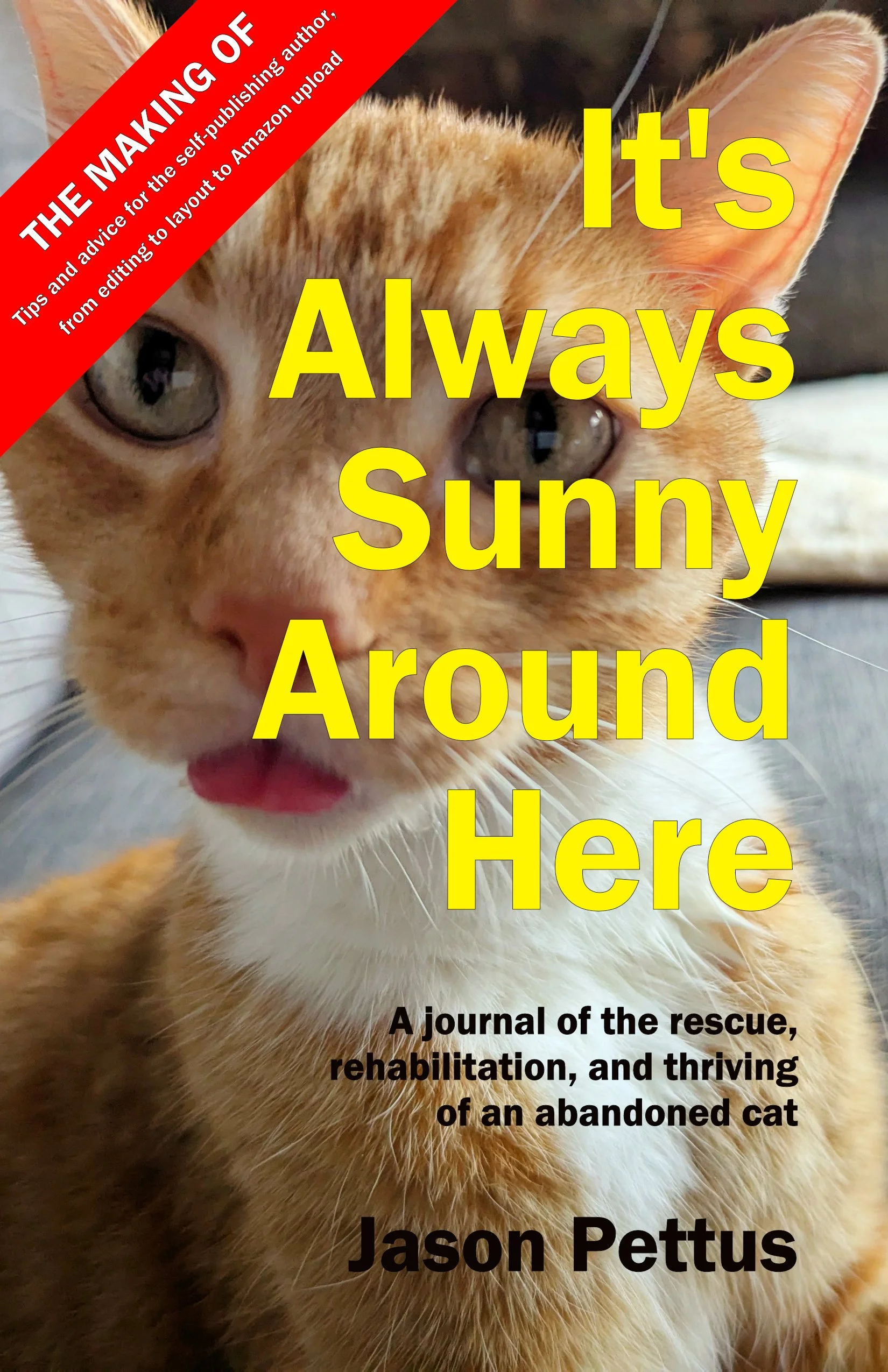
To read this making-of guide as a downloadable ebook, click here for the EPUB and click here for the Kindle version (AZW). To look at and/or buy the book being discussed, head over to Amazon.
In summer and autumn of 2025, I ended up writing an almost daily journal about my rescue of an abandoned cat named Sunny, originally on the advice of cat behaviorist Jackson Galaxy so that I could keep detailed track of his habits and food intake. By the time I finished the journal that November, I had amassed 40,000 words, and realized it would make a great project to take on first in my new plans in 2026 to begin self-publishing some books of mine for the first time in decades.
With both this book and all the other ones I’ve since done, the hope is to write a series of essays about how I accomplished each step of the self-publishing process, what software I used, what I thought of that software, and how other self-publishing authors can duplicate the steps. The goal is always to put these books out using as close to a staff of one (me) and an upfront budget of zero as possible, just to prove it can be done, although of course I always encourage you to hire professionals if you can afford it. I’m releasing all these essays, linked together on a central page, for free at my freelancing website, as a way of attracting attention to my practice from people searching on these subjects at Google. I’ve also collected all the essays and have published them as a standalone ebook, which you can download for free at the top of this page.
The first thing I did was move my first draft off of Google Docs and into a Microsoft Word file. I then gave it a first round of editing (chapter 1), doing both a developmental edit and copy edit at the same time while “track changes” was on.
After that I revised the manuscript, based on what those editing notes revealed, then went through a second round of editing (chapter 2). After some contemplation, I made a decision about the manuscript that necessitated a third and fourth round of editing as well (chapter 3).
At that point I then declared the manuscript “locked down” and proceeded to the layout of the paperback (chapter 4). I also finalized the cover art during this period (chapter 5). The two of these steps together are known as the book’s production.
After finishing that and outputting a PDF proof, I did a post-production proofread (chapter 6), not only for any final typos in the manuscript but errors in the layout phase.
I then incorporated those final proofing notes into the finished paperback version, as well as a new fifth edit of the Word file. I used version 5 as the basis for the ebook (chapter 7), which required two different pieces of software and a lot of fine-tuning.
I then assembled all the book’s metadata (chapter 8), including its description, its BISAC categories, its Amazon keyword phrases, its ISBN, its ASIN, its height and weight data, what its retail price is to be, and more.
I then uploaded all the pieces to Amazon and troubleshot the problems (chapter 9), put the project in draft status while I waited for a physical proof to arrive in the mail, reviewed and approved the proof, and told Amazon to change its status from “draft” to “active,” making it available to the public.
Finally, you might be wondering why I didn’t make an audiobook as part of this process, and why I didn’t bother marketing or promoting this particular title, so I wanted to address that too (chapter 10).
I hope these essays are of some use to you, and please always feel free to drop me a line with questions or comments to ilikejason@gmail.com. I continue to write, self-edit, self-design, and self-publish books—then self-analyze them afterwards for my website—as part of promoting my freelancing practice; you can find them all at https://Pettus.rocks/tutorials.