The Making of'It's Always Sunny Around Here'Chapter 2: Revisions and Second Edit
To read this making-of guide as a downloadable ebook, click here for the EPUB and click here for the Kindle version (AZW). To look at and/or buy the book being discussed, head over to Amazon.
(Click here for the Microsoft Word file of this second edit, with “track changes” still turned on. Click on any of the images below for the full-sized version.)
Since this book is doubling as an advertisement for my freelancing services, let me take a moment at the beginning of this chapter and mention that if you’re working with an outside editor, you are absolutely under no obligation to accept every piece of advice they give you, whether those are bigger notes as comments along the edges of the pages, or the suggestion of a new word embedded within some long paragraph on page 47. That’s not the goal, especially with creative writing (which I’m defining here as any book that comes out commercially through Amazon, as opposed to a doctoral dissertation or an industry guidebook), and in fact most of my clients tell me that they’re quite happy when they agree with only 90 to 95 percent of my suggestions. This is an inherent aspect of creativity; it’s a very unique endeavor, one that only needs to deeply resonate with the person actually creating the project, so sometimes other humans simply get that resonation a little wrong.
Since we’re acting as our own editors in this case, though, we don’t need to worry about that, so we’re going to assume that Author Us agrees 100 percent with everything Editor Us suggested during the edit, and is ready to simply accept all the changes and then implement the revisions they suggested in the comments. In my case, for example, Editor Jason agreed that Author Jason went on in too much detail about the mental illness of the cat’s former owner, and urged him to cut almost all of it out; he also reminded Author Jason that in these kinds of memoirs, people like his housemates are typically referred to just by their first letter. He also suggested changing R-rated curse words in the manuscript (like “shit”) into PG ones (like “crap”), because why purposely limit your audience in that way if you don’t have to? Editor Jason ended up suggesting a total of 1,067 revisions in a 44,000-word manuscript; Author Jason approved them all, and the word count afterwards was 40,000.
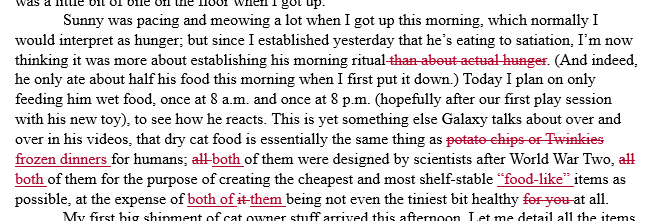
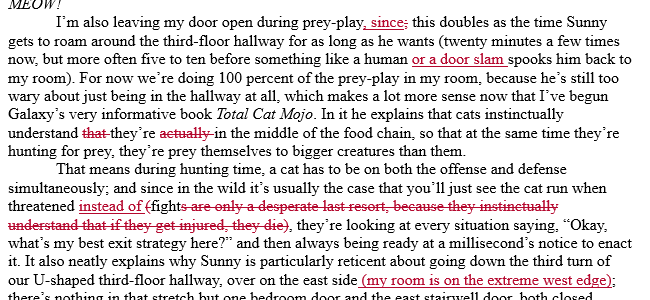
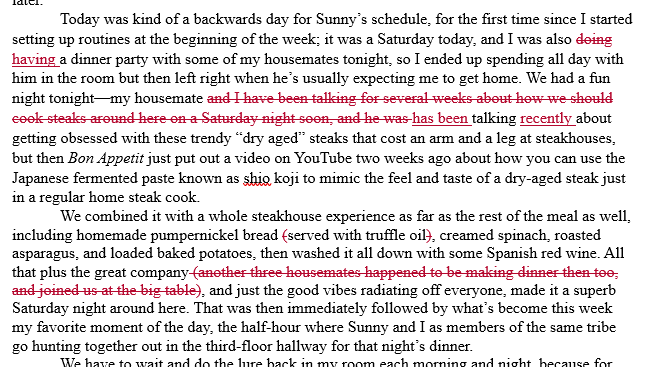
Since I was acting as my own editor here, at this point I decided to just launch straight into another full edit of the entire manuscript from start to finish; but realize that if you hire a freelance editor, they’ll most likely charge you extra for a second round like this, so a lot of authors skip this step when they’re working with an outside person. In my case, I found another 300 or so errors, much of them much more technical things, not just catching missed tiny typos but also truncating text (in one example, from using “Twinkies and potato chips” to describe 1950s food science innovations to the shorter and more evocative “frozen dinners”), and continuing to sometimes cut out entire sentences when I felt an anecdote was going on a little too long. Journals are inherently self-indulgent documents; you always find yourself cutting more and more and more when it comes time to publish a book version.
At the end of that process, I found myself with a tight 39,000-word manuscript, perfect for a novella-sized book, which was my only goal since I’m publishing these books mostly for these essays I write afterwards, not for any particular money or popularity with the books themselves. Normally at that point I would be ready to move on to the design phase; but before being done with the text for good, I made a decision that ended up having rather big repercussions. That’s detailed in the chapter coming next.